THE HUMAN OPERATING SYSTEM: Why Personal Transformation Requires Updating Your Hardware, Root Code, Drivers, Apps & Operating System
A foundational guide for anyone beginning – or deepening – their inner work
Most people believe their personality is fixed.
“This is just how I am.”
“You have to accept me the way I am.”
“I can’t change how my mind works.”
“That’s just my nature.”
But in reality, most of what people call “personality” is not personality at all. It’s programming — often old, outdated, or inherited programming.
And the biggest misunderstanding of all? People confuse their coping mechanisms with their identity.
Shutdown responses get mislabelled as character traits.
Emotional numbness gets framed as “just how I’m wired.”
Avoidance and conflict-fear get mistaken for personality.
Overthinking or detachment get treated as fixed traits.
But these patterns are not identity. They are systems that were installed early in life and never updated. They live in your “human operating system” — the deeper architecture that quietly determines how you think, feel, behave and relate. And whenever you try to change your life, business, relationships or leadership, you eventually hit the same reality:
You can’t build a new identity on top of old code.
And you can’t upgrade your life using an outdated operating system.
The computer metaphor makes this much easier to understand.
It shows you where personal development gets stuck, why mindset work alone doesn’t hold, and why real transformation requires a whole-system approach.
The Human Operating System: A Full Breakdown
(simple enough for anyone to understand, deep enough to change your life)
There’s something I’ve never really said out loud until now. And it might be a bit of an unpopular opinion. Below is the entire framework you can use to understand yourself without shame, judgement, or psychological jargon.
Think of yourself as a whole system.
You aren’t just a mind, a body, a personality, a set of thoughts or a set of habits. You are a multi-layered operating system, and each layer needs attention.
Let’s walk through the architecture.
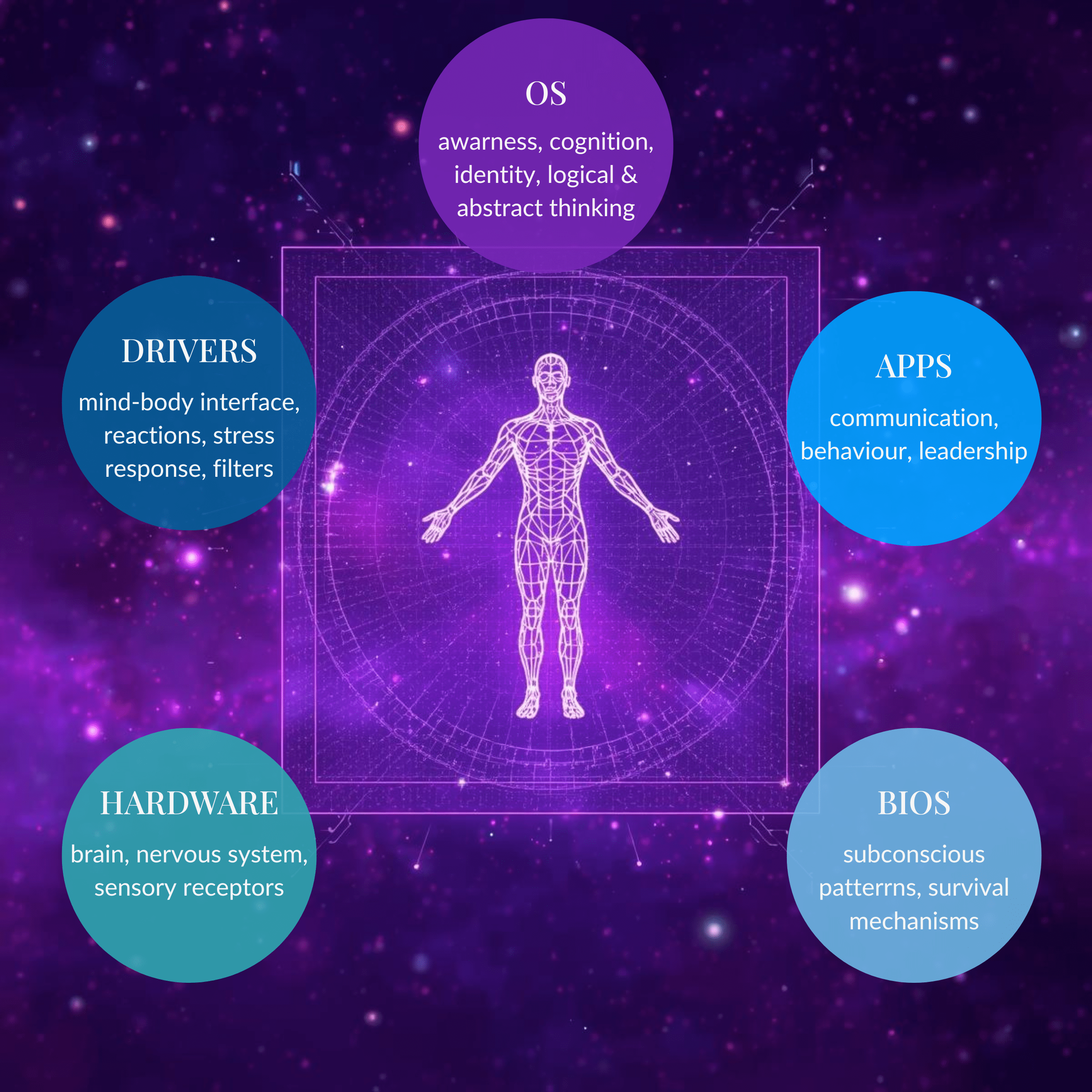
NOTE ON THE BELOW METAPHOR: This model simplifies extremely complex human processes. In reality, these layers influence one another in overlapping, nonlinear, and sometimes unpredictable ways. You won’t find clear boundaries between them in the brain or body, but the metaphor helps you understand how different parts of your inner system interact, and why real transformation requires attention across multiple layers.
HARDWARE
This is your biological infrastructure: the physical machine through which every thought, feeling and behaviour is expressed. It includes:
Most people assume this layer is fixed. It isn’t. Neuroplasticity = the brain’s ability to rewire itself. Unlike a computer, you don’t need to replace parts. Your brain creates new connections every time you:
- learn something new
- pause and reflect
- examine a reaction
- change a habit
- try a different behaviour
- disrupt an old thought
- practice presence
- regulate your nervous system
These micro-shifts strengthen neural pathways, much like upgrading RAM, boosting processing speed or reinforcing circuitry. The body is part of identity and it can evolve. Upgrades are possible, but not magical — the process depends on time, support, consent, repetition, and sometimes external help.
BIOS / ROOTCODE
This is the deepest layer of the system. In a computer, BIOS (or root code) is what loads before the operating system. It sets the rules. It tells the machine HOW it’s allowed to function. In humans, this is:
This root code forms before age seven. You didn’t create it. It was installed in you. And it affects EVERYTHING:
- how you interpret the world
- how you respond to stress
- how you perceive yourself
- how you relate to others
- what you believe you deserve
- how you handle conflict
- how you express emotions
- how you suppress emotions
- how you show up in your business
- how safe or unsafe life feels
- how you make decisions
If your BIOS is outdated, your entire system will run on the logic of your past. This is why adults say things like: “I don’t know why I react like this.”, “I feel blocked.”, “I know better, but I can’t do better.”
The issue is not the willpower. It’s the root code still running the show.
DRIVERS
Drivers tell the operating system how to communicate with the hardware. In humans, “drivers” are:
Many of your drivers — the automatic patterns of reaction, attention, emotion, survival — were shaped not only by early childhood coding, but by ongoing social interactions: family, friendships, work environment, culture, community. Every relationship, social expectation and shared trauma can affect how your system runs. Recognising this is important. Your internal wiring is shaped in conversation with others — sometimes consciously, often unconsciously.
When drivers are outdated, the system misfires. You may disconnect from your body, react impulsively, freeze in overwhelm, avoid necessary conversations or default to old behaviours under stress. Driver updates happen through small, repeatable steps:
- noticing a reaction
- naming a feeling
- pausing before responding
- practising micro-boundaries
- allowing discomfort
- slowing down reactivity
- tracking behavioural patterns
Each small moment of awareness = a driver patch.
OPERATING SYSTEM
The OS is the layer most people try to change first — because it’s where mindset lives. But mindset work collapses under pressure if deeper layers aren’t updated. Your OS includes:
When the OS updates, your internal world changes:
- your sense of self expands
- your emotional bandwidth increases
- your interpretation of life becomes more coherent
- your intuition strengthens
- your choices become more aligned
But OS upgrades only stabilise when your hardware, root code and drivers support them. You cannot run OS Version 25 on BIOS Version 2 and your drivers are running Version 4. Your OS can’t run the new code because the root code hasn’t been updated, the drivers are still outdated, and / or the hardware is still wired for survival. This is why “mindset-only work” doesn’t stick.
When the OS tries to update without system support, you get: relapse into old habits, temporary change that doesn’t hold, emotional shutdown, shame spirals (“I should be better than this”, “What is wrong with me?”), feeling like you’re failing when you are simply overloaded. Identity shifts only stabilise when: the hardware is regulated, the root code is updated, the drivers are communicating clearly, the OS has a supportive structure. This is the turning point where “who I had to be” collapses and “who I actually am” emerges.
Your Social Operating System Matters Too – Transformation isn’t only internal. Your relationships, community, and environment form an external system that interacts with your inner one. As you upgrade your internal OS, you may also need to update or reconfigure your external network — set boundaries, build new connections, or release outdated relational patterns. True alignment often involves both systems.
APPLICATIONS
This is what people SEE. It’s the external result of your internal system. Apps include:
Outdated BIOS → outdated behaviours
Unstable drivers → inconsistent habits
Overwhelmed hardware → reactivity
Unsupported OS → unclear action
When someone tries to change behaviour without updating the architecture beneath it, they experience collapse, relapse, sabotage or shutdown.
Apps work best when they run on: regulated hardware, updated root code, functional emotional drivers, a coherent operating system This is when behavioural change becomes sustainable.
Note that our outward behaviour is not only shaped by our internal system but also by the external networks we interact with — family, work, culture, and community.
Keep in mind: These layers don’t function as isolated parts. They operate as one interconnected system. Changing one affects all the others. Sometimes you’ll focus deeply on one layer; other times several layers update together. This is not a scientific diagram — it’s a practical map to help you understand what’s happening beneath the surface when change feels easy, impossible, slow, or sudden.
Your Human Network Layer
Just like a computer doesn’t function alone but connects to networks, servers, routers and the wider internet, human beings are wired for connection.
Your “local network” is your family, close relationships, immediate environment. Your “wireless network” includes friends, community, culture, education, and the people you interact with throughout life. Your “internet layer” represents collective consciousness — the shared beliefs, norms, emotional climates, and archetypal patterns you absorb without realising it.
Every one of these networks sends information into your system. Some inputs expand you; others restrict you. Personal transformation often requires not only updating your internal architecture, but also intentionally upgrading the networks you connect to: setting boundaries, choosing new environments, strengthening supportive connections, and reducing exposure to systems that reinforce outdated code.
The Transformation Truth
You Cannot Change ONE System Layer Without Touching the Others
You cannot change one layer without affecting the others.
Updating mindset alone doesn’t work if:
- the nervous system is overwhelmed
- your BIOS still runs on survival
- your drivers collapse under stress
- your OS can’t run the change you’re trying to implement
Real transformation is systemic. Sometimes you get a quantum leap — a hardware upgrade, a root code shift, and an OS update all at once. But most of the time? It’s incremental:
5 → 5.1 → 5.2 → 6.0 → 6.1 → 6.10 → 6.150 → 7.0
Every micro-upgrade matters.
Every small decision counts.
Every pause rewires something.
Every moment of awareness strengthens the circuitry.
This is identity work.
This is inner alchemy.
This is transformation.
This is Brand Alchemi.
What to take away from all this
You are not fixed.
You are not your coping mechanisms.
You are not your early programming.
Your brain is upgradeable.
Your emotional system is upgradeable.
Your beliefs are upgradeable.
Your whole operating system can evolve.
And when you update the system, everything else updates with it: identity, behaviour, relationships, business, leadership, and life.
One update at a time.
✧ Ready to Start Updating Your Human Operating System? ✧
If this framework sparked recognition or clarity, consider this your invitation to take the next step. Nothing about you is fixed; every layer of your system is upgradeable: one insight, one decision, one update at a time.
If you’re at the beginning of this work, you can start by mapping your emotional programming. If you’re ready to go deeper, explore the subconscious patterns that shaped your identity. And if you’re in a phase of rebuilding, there’s a way to discover the blueprint of who you’re becoming.
Begin with Emotional Archetype Decoder – discover your core emotional coping style and unconscious patterns that still run the show. Fast, insightful and completely free.


Dive into your root code – a guided journey designed to bring hidden patterns to the surface.
Build your new identity map – If you’re ready for clarity, direction, and a sense of inner alignment, this is your next step.

I work with branding at the level where identity comes before strategy.My approach emerged through years of noticing where traditional branding works on paper but breaks down in practice, especially during periods of personal evolution.
I integrate symbolic identity systems, AI-assisted pattern analysis, and deep emotional insight to map the underlying architecture that shapes how people lead, communicate, and are perceived. Not to create a persona, but to reveal what is already operating beneath conditioning, adaptation, and survival strategies.
This is identity-led branding as a form of personal transformation expressed outwardly. The work focuses on coherence, not performance, and on restoring alignment between internal state and external expression.
For some, that expression takes shape through language, strategy, and visibility. For others, it extends into visual embodiment, where photography reflects identity shifts and leadership presence at the moment someone is ready to be seen.